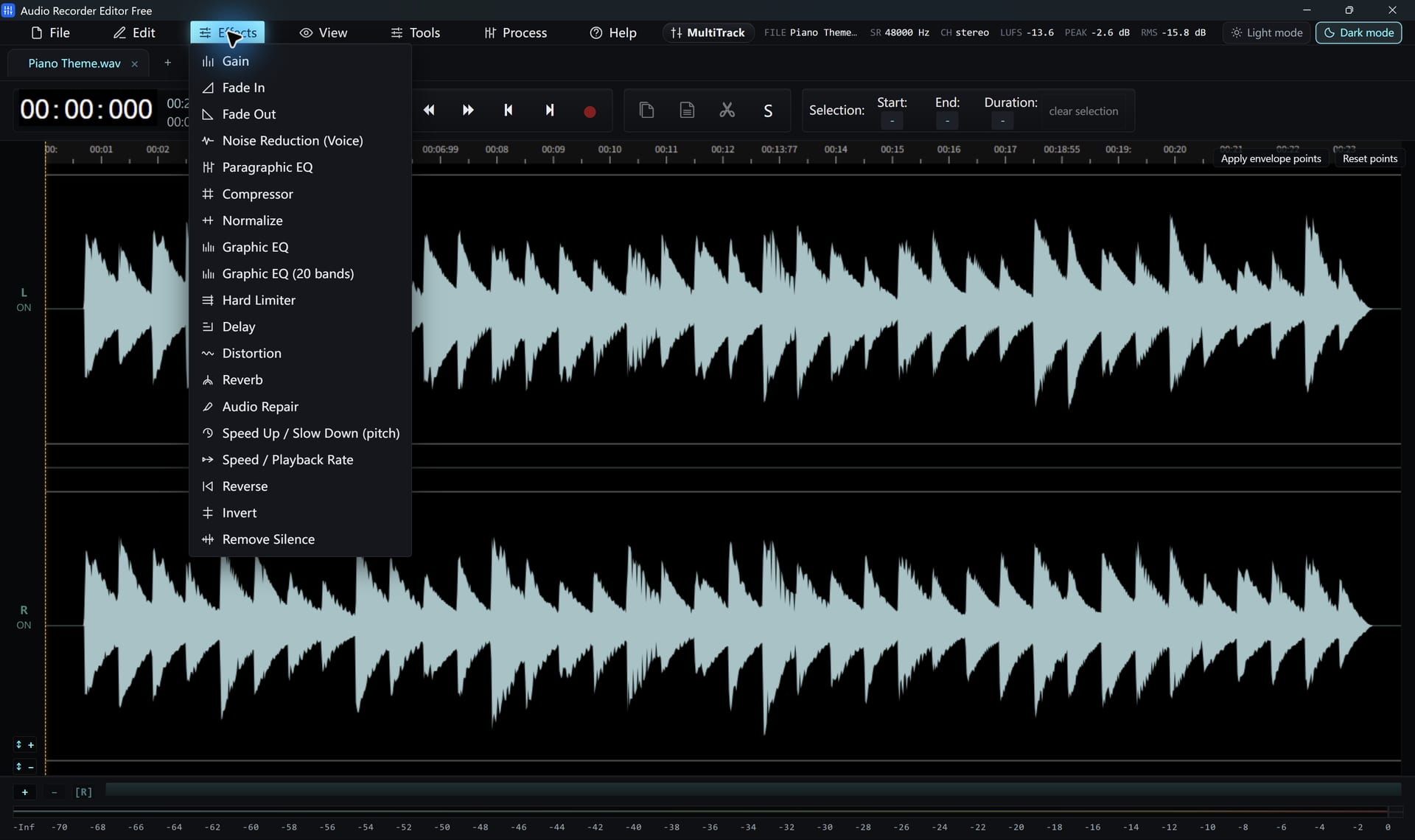
Apply an effect
- Select part of the waveform, or press Ctrl+A to select the whole file.
- Open the Effects menu and pick an effect.
- Adjust the controls and click Preview to listen.
- Click Apply. If you don’t like it, press Ctrl+Z.
Which effect does what
| Effect | Use it to |
|---|---|
| Gain | Make a section louder or quieter |
| Normalize | Raise the whole file to a consistent peak level |
| Graphic EQ (10 or 20 bands) | Add bass, reduce boominess or brighten a voice |
| Paragraphic EQ | Shape the sound with precise, movable filter points |
| Compressor / Hard Limiter | Even out loud and quiet parts, stop peaks clipping |
| Reverb / Delay | Add space or an echo |
| Speed / Playback Rate | Speed up or slow down a recording |
| Reverse, Invert | Play backwards, flip polarity |
| Fade In / Fade Out | Start and end smoothly |
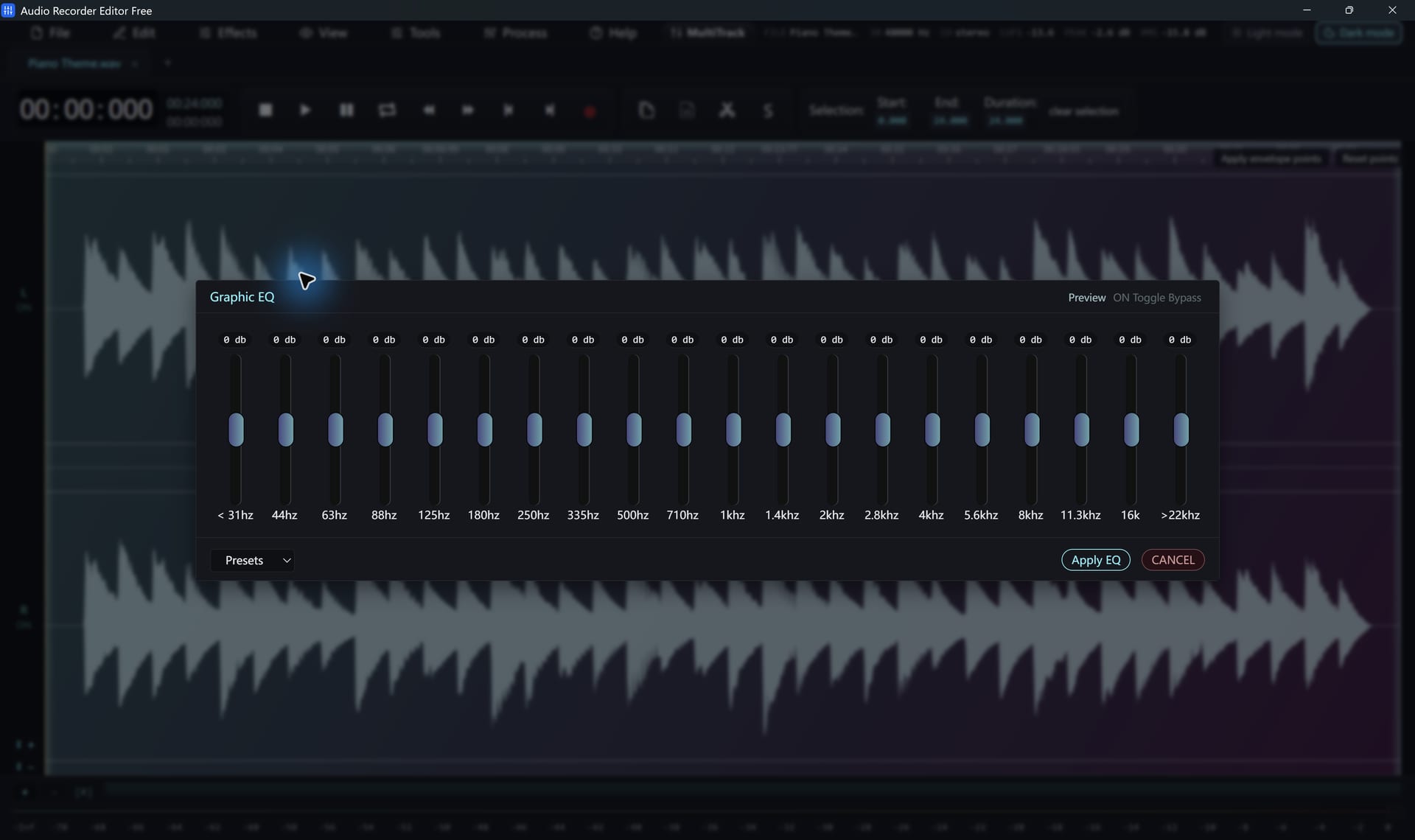
Save your own presets
In effects that support presets, set the controls, choose Save preset and give it a name, for example “My podcast voice”. Next time it is one click away.
For voice recordings, the Podcast chain combines gate, EQ, compression, de-essing, de-breathing and loudness in one pass. See how to remove background noise.
Questions about this task
Can I undo an effect after applying it?
Yes. Press Ctrl+Z, or use the history drawer to go back several steps.
Does it support VST plugins?
No. It uses its own built-in effects.
Can I apply an effect to just part of a file?
Yes. Select the part first; effects apply only to the selection. With nothing selected, select all with Ctrl+A.
How do I make a voice sound clearer?
Try the graphic EQ: reduce around 200–300 Hz if it sounds muddy and add a little around 3–5 kHz for clarity. Then use the compressor and normalize for an even level.
Try It On Your Own Audio
Audio Recorder Editor Free costs nothing. Install it and follow along.
Download Free for WindowsFree forever · Windows 11 & 10 (64-bit) · No registration